
CDE Innovation Prism
Concept definition
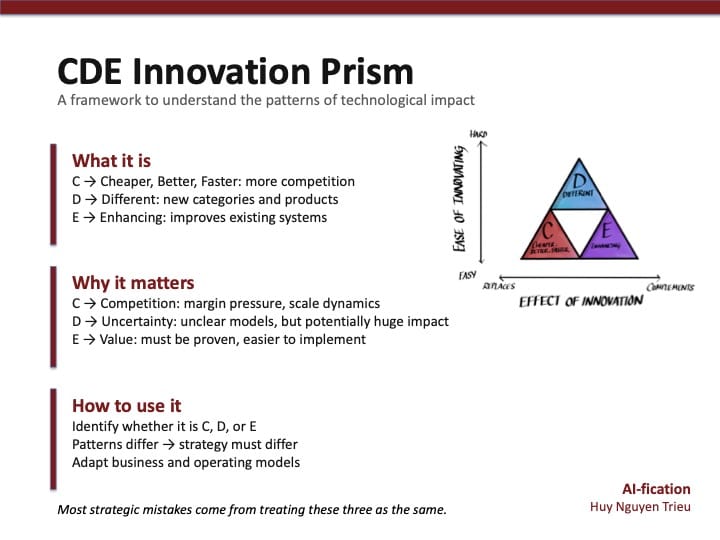
The CDE Innovation Prism (Cheaper-Better-Faster / Different / Enhancing) is a model created in 2015 to understand how technology creates impact.
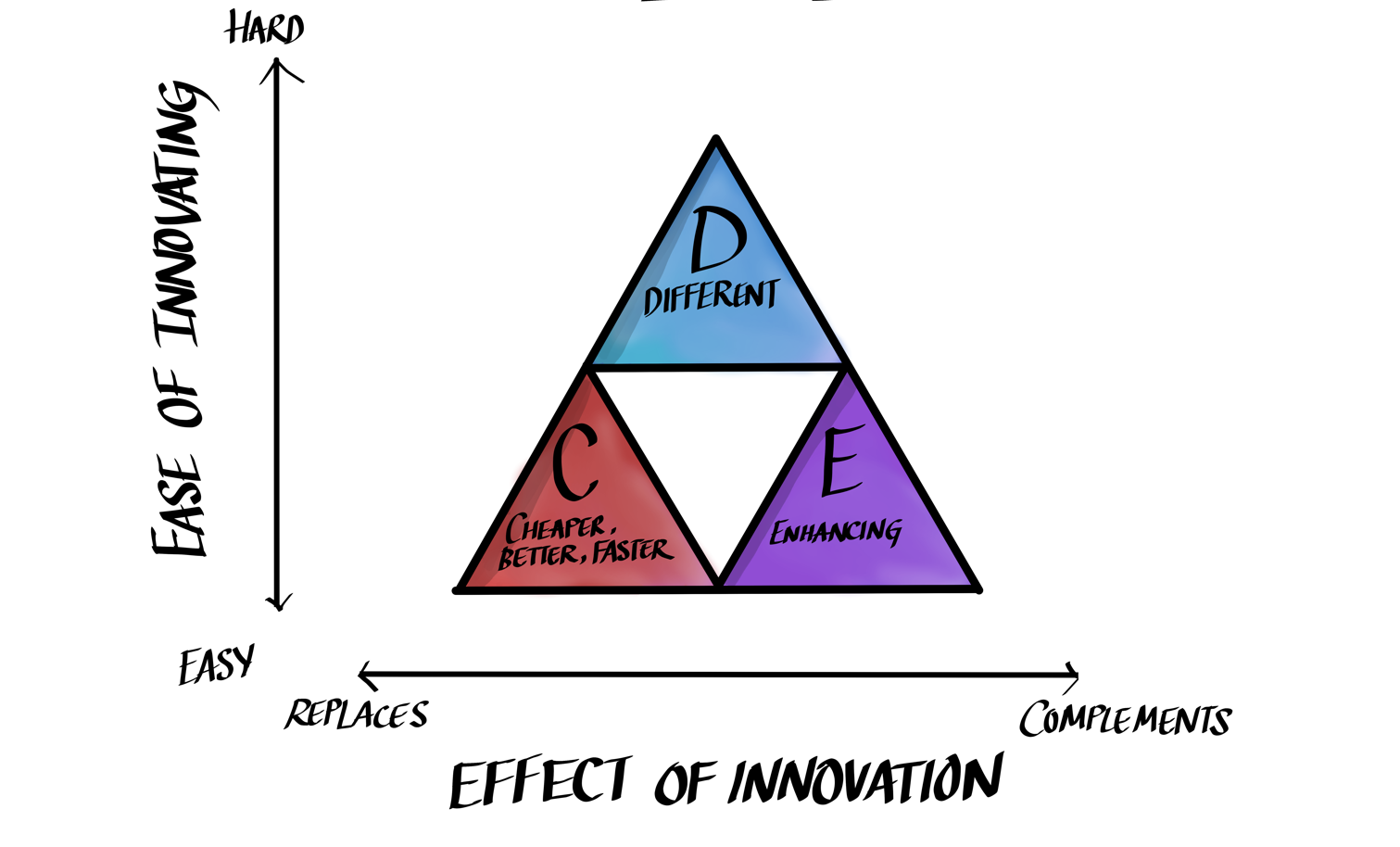
It distinguishes between three types of innovation:
- C - Cheaper, Better, Faster: technology used to compete directly with existing models - not simply to improve them, but to displace them
- D - Different: innovation that creates something fundamentally new - a new category, a new behaviour, a new market
- E - Enhancing: innovation that increases the value of what already exists, without replacing it
Since 2015, I’ve used this framework to explain technological impact across Fintech, AI, and organisational transformation.
Why it matters
The world feels harder to read.
Technology moves faster. New companies, products, and categories appear constantly. Established players can be disrupted in a few years - sometimes in a few months. And as the pace accelerates, it becomes harder to anticipate what matters, harder to build a coherent strategy, and harder to know where to focus.
The instinctive response is to study examples. To analyse each company, each product, each use case in detail.
But this does not scale. And it often mistakes noise for signal.
What I observed early on - and what has remained true across many sectors and contexts - is that despite the apparent complexity, technological innovation tends to follow a small number of patterns.
Companies that look completely different on the surface often follow very similar underlying dynamics. The chaos is not random.
The CDE Innovation Prism is a way to make those patterns visible - and to think more clearly about what is likely to happen next.
Origin
I developed the initial version of the framework in 2015.
At the time, fintech was expanding rapidly. Thousands of startups were being created, each with different products, narratives, and business models. I was working at Citi, and at the same time teaching at Oxford Said Business School, trying to explain what was happening to senior audiences.
The challenge was clear: making sense of fintech required going through hundreds of individual use cases. There was no simple way to organise the complexity.
What I needed was a way to identify patterns beneath the surface.
The first version of the model distinguished between two types of innovation:
- those that were cheaper, better, or faster - competing directly with existing models
- those that were different - creating something that had not previously existed
That distinction proved immediately useful. It gave people a way to categorise what they were seeing, and to understand the strategic implications.
Over time, I added a third category - Enhancing - to capture innovation that neither replaces nor creates something entirely new, but increases the value of what already exists.
The model
C - Cheaper, Better, Faster
This is where technology is used to compete directly with existing players in an existing market.
The objective is not simply to improve an activity. It is to offer a meaningfully better value proposition - lower cost, higher quality, greater speed - in a space where incumbents already operate.
This type of innovation typically produces:
- intense direct competition
- margin pressure across the market
- rapid scaling dynamics, where execution and distribution matter most
- winner-takes-most or winner-takes-all outcomes in some segments
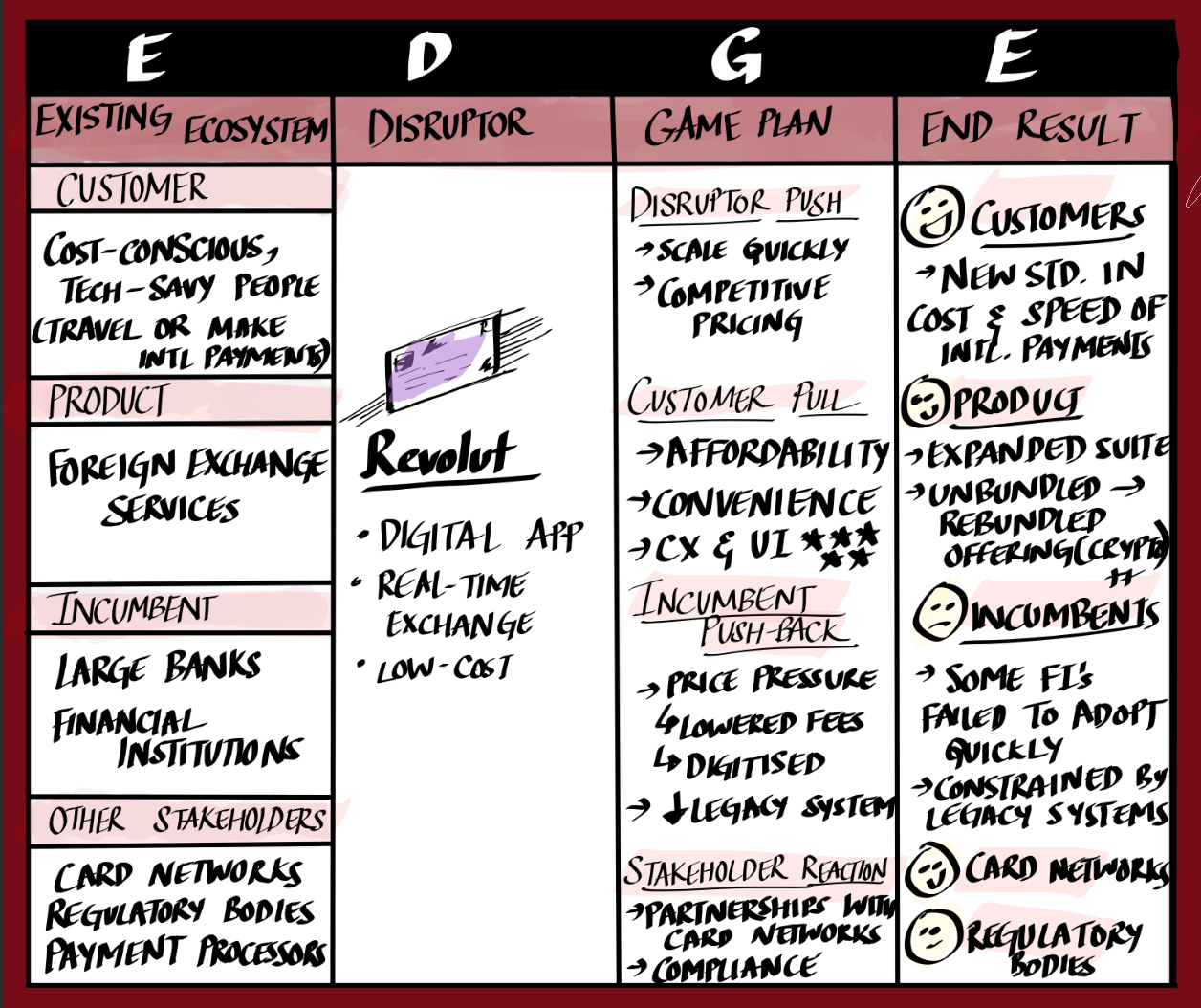
Examples: Amazon competing with bookshops and then retail broadly - Revolut in foreign exchange and payments
D - Different
This is innovation that creates something fundamentally new.
It does not simply compete with an existing product. It changes the category entirely, or creates one that did not exist before. Often, it changes behaviour - how people communicate, transact, find information, or create.
These innovations are typically:
- difficult to understand at the beginning
- product-driven rather than market-driven
- uncertain in terms of business model and long-term value capture
- high impact, but hard to predict in direction and timing
Examples: Facebook - Google - Bitcoin - Generative AI - Agentic AI
E - Enhancing
This is innovation that increases the value of existing processes, systems, or activities.
It does not replace them. It does not create a new category. Instead, it makes something that already exists work better - faster, more accurately, at lower cost, or with greater insight.
Because it operates within existing systems, it must demonstrate its value clearly and integrate effectively.
Example: Salesforce improving how organisations manage customer relationships
Implications
The value of the CDE Innovation Prism is not only to classify innovation. It is to understand what tends to happen next.
Each of the three types follows recognisable patterns - which makes it possible to anticipate how markets evolve, what challenges are likely to emerge, and what kind of strategic response may be required.
C - Cheaper, Better, Faster
This type leads to direct, intense competition.
Once technology makes it possible to do something cheaper, better, or faster, multiple players typically enter the same space with similar value propositions. The result is margin compression, rapid commoditisation, and strong pressure on execution and scale.
In these markets, differentiation is difficult. Distribution, cost efficiency, and speed of execution tend to matter more than the original innovation itself. Winner-takes-most dynamics are common.
Amazon illustrates this well: the original insight - selling books online more cheaply - was quickly followed by expansion into every product category, where execution and logistics became the primary competitive advantage.
D - Different
This is the hardest type to understand and model.
When something genuinely new is created, the business model is often unclear at the beginning. The market does not yet know how to value it. The competitive landscape has not yet formed. And early assumptions about who will win are frequently wrong.
Google was not the first search engine - but it was the first to find a scalable business model around search. The technology came before the monetisation strategy.
Generative AI follows a similar pattern today: the impact is already clear and significant, but how value will be captured in the long run - which players, which models, which layers of the stack - remains genuinely uncertain.
Different innovation requires a different strategic mindset: more patience, more tolerance for ambiguity, and more willingness to revise assumptions as the landscape becomes clearer.
E - Enhancing
Enhancing innovation can also lead to strong competition - but in a different way.
Because it operates within existing systems and activities, it must prove its value to those systems. Adoption depends on demonstrated usefulness, quality of integration, and the ability to show clear return within the existing context.
The business model is not always immediately obvious. And unlike Cheaper-Better-Faster innovation, success here is measured not by displacement but by depth of adoption and dependency.
How to apply it
At its simplest, the framework can be applied through three diagnostic questions:
- Is this innovation competing directly with something that already exists? - C
- Is it creating something fundamentally new - a new category or behaviour? - D
- Is it improving or extending an existing process or system? - E
These questions can be applied to a company, a product, a technology, or a market trend. They help surface the likely dynamics - and the type of strategic response that may be appropriate.
I have also developed a broader application approach, called EDGE, which builds on CDE to analyse technological impact more systematically across organisations and sectors.
Where it has been used
The CDE Innovation Prism was originally developed in fintech, as a way to make sense of a rapidly expanding landscape of companies, products, and narratives.
Since then, it has been applied across AI, strategy, entrepreneurship, and organisational transformation - including in work with senior leadership teams, policymakers, and educators.
It has been used as a teaching framework at business schools, as a strategic tool in corporate settings, and as a lens for analysing emerging technologies including Generative AI and Agentic AI.
Closing
The world of technology will continue to feel fast, complex, and difficult to read.
But complexity does not mean randomness.
Beneath the noise, technological innovation tends to follow recurring patterns. Recognising those patterns does not make the future predictable - but it makes it more legible. It helps identify what is likely to happen, what kinds of challenges will emerge, and what type of response may be required.
The CDE Innovation Prism is a way to see those patterns clearly.
Summary
The CDE Innovation Prism identifies three patterns of technological impact:
- C - Cheaper, Better, Faster - direct competition with existing models, leading to margin pressure, scale dynamics, and winner-takes-most markets
- D - Different - creation of new categories, often with high impact but unclear business models, early uncertainty, and shifting leadership
- E - Enhancing - improvement of existing systems, where value must be demonstrated clearly within existing activities, and adoption depends on integration and usefulness
The framework helps identify how innovation tends to evolve, what kinds of challenges are likely to emerge, and what type of strategic response each pattern may require.