
Performance Hexagon
Concept definition
The Performance Hexagon is a framework for understanding how people create value in the age of AI.
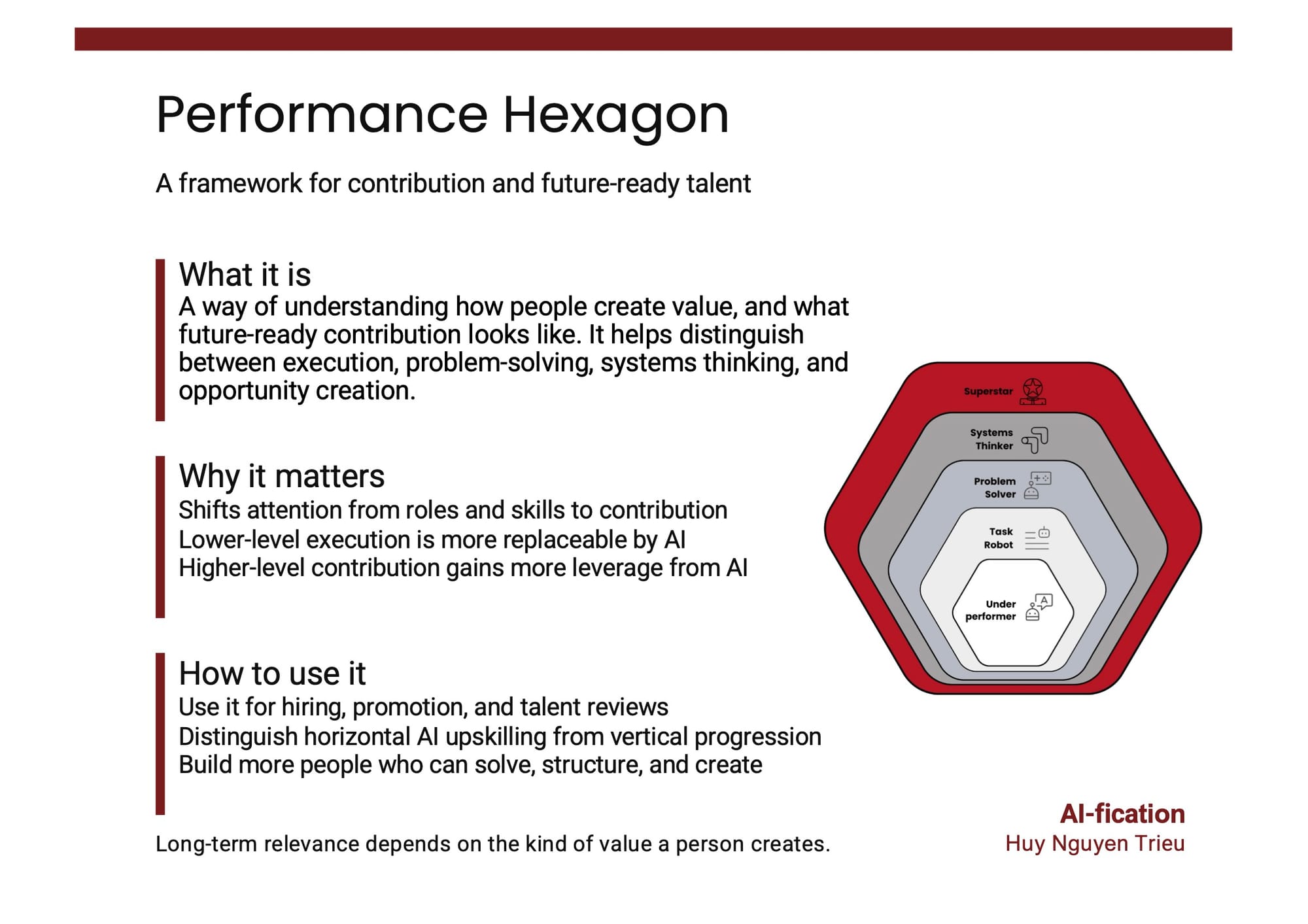
Rather than classifying people by title, seniority, or technical skills alone, it maps them by the nature of their contribution - how they execute, solve problems, build systems, and identify opportunities. It distinguishes between five broad patterns of contribution:
- Underperformer — requires supervision; output is limited and unreliable
- Task Robot — executes defined tasks reliably but only within given instructions
- Problem Solver — identifies and resolves problems independently without being told how
- System Thinker — designs structures and processes that solve problems at a higher level of abstraction
- Superstar — creates new categories of value; identifies opportunities others do not see
Introduced in The AI-fication of Talents Whitepaper by CFTE. Applied to hiring, development, workforce planning, and capability strategy across individuals, organisations, and nations.
The framework shifts attention from credentials to contribution, asking not only what people know, but how they create value.
Why it matters
The original challenge behind the Performance Hexagon is becoming more important as AI progresses. When technology changes slowly, organisations can rely more heavily on familiar indicators such as credentials, years of experience, or a short list of technical skills. But when tools, workflows, and business models evolve quickly, those indicators become less reliable.
The AI-fication of Talents Whitepaper by CFTE argues that traditional predictors of success no longer work as well as they used to. Two individuals with the same title, similar experience, and comparable technical proficiency can face very different outcomes. One may become more valuable by using AI to increase leverage. Another may lose relevance because the work remains too defined and too easy to automate.
That is why the Performance Hexagon matters now. It helps leaders, educators, and policymakers focus on the kind of contribution a person can make, not only on the credentials they hold. It is therefore useful for hiring, development, workforce planning, and wider capability strategy.
Origin
The Performance Hexagon was developed as part of The AI-fication of Talents Whitepaper by CFTE. The starting question was straightforward but difficult: if job titles, seniority, and technical skills are no longer sufficient predictors of success, what does predict high performance in an AI world?
The answer was to shift from labels to contribution. Instead of classifying people by their formal role, the framework looks at how they operate: whether they mainly execute defined tasks, solve independent problems, build repeatable systems, or create new forms of value. This change in perspective makes talent easier to read in a period of rapid technological change.
The model
The Performance Hexagon describes five broad categories of contribution. These are not job titles. They are patterns of how individuals create value.
Underperformer
Struggles to deliver reliably. Requires supervision, additional support, or correction. Instead of creating leverage, requires high maintenance.
Task Robot
Delivers reliably when given clear instructions. Executes tasks efficiently and consistently, but mainly within defined parameters.
Problem Solver
Moves beyond task execution. Solves problems independently when presented with challenges or objectives and gets things done without detailed guidance.
System Thinker
Sees patterns, builds structures, and designs processes to solve categories of problems systematically. Scales solutions beyond individual cases.
Superstar
Identifies opportunities without needing direction. Defines problems, imagines new possibilities, and creates new systems, initiatives, or businesses.
What makes the framework useful is that it describes contribution across two dimensions. Moving up the Hexagon means moving towards work that is less defined, more complex, and harder to replace. Moving across it means moving towards contribution that creates greater leverage and more value.
Important clarifications
The Hexagon is not a fixed ranking of human worth. It is a practical model for understanding contribution in context. The same individual may operate as a Problem Solver in one environment and as a Task Robot in another.
The categories are not mutually exclusive. Many strong contributors combine features across adjacent levels. A System Thinker may also spot opportunities like a Superstar. A Problem Solver may still be excellent at disciplined execution.
The framework should therefore be used as a dynamic lens, not as a rigid label. Its value lies in making patterns visible and helping leaders think more clearly about what kind of capability they are building.
AI and the Hexagon
At the lower levels of the Hexagon, where work is structured, repeatable, and clearly defined, AI is more likely to replace human execution.
At the higher levels, AI amplifies human contribution — helping people solve problems faster, design systems more effectively, and explore opportunities at lower cost. It does not move people up the Hexagon. That movement depends on capability, not tools.
At the higher levels, AI behaves differently. Problem Solvers can use AI to find solutions faster. System Thinkers can use it to automate workflows, feedback loops, and operating structures. Superstars can use it to explore ideas, test strategies at low cost, and create new systems more quickly than before.
AI upskilling alone is not sufficient. The real advantage comes from combining horizontal improvement — using AI tools more effectively — with vertical progression: building the judgement, systems thinking, and initiative that move someone up the Hexagon. Only vertical progression changes what someone is capable of contributing.
How to apply it
For leaders: use the Hexagon to define what level of contribution a role requires, assess current team distribution, identify where to develop and where to hire, and design progression pathways that move people toward higher contribution.
The Performance Hexagon can be applied at three levels: personal, organisational, and national.
For individuals
It helps people understand how they currently contribute, where they may be limited by task-based execution, and what kind of development could help them move towards stronger problem solving, systems thinking, and opportunity creation.
For organisations
It provides a shared language for what higher-value contribution looks like across functions. It can support hiring, talent reviews, leadership development, role design, and the creation of more personalised capability journeys - not only by asking who can use AI tools, but who can think, adapt, and create leverage.
For nations and public capability programmes
It offers a scalable way to think about readiness beyond narrow technical training. It helps frame what kind of contribution matters, how to segment populations, and how to design pathways that move more people towards higher-value forms of contribution over time.
Its value becomes especially clear at scale. When leaders try to prepare a whole organisation - or even a nation - they quickly face difficult questions: what really matters, how should it be measured, and how can development be personalised without creating unmanageable complexity. The Performance Hexagon helps by offering a simple but meaningful structure that can be applied across many roles and contexts.
AI upskilling alone is not sufficient. The real advantage comes from combining horizontal improvement — using AI tools more effectively — with vertical progression: building the judgement, systems thinking, and initiative that move someone up the Hexagon. Only vertical progression changes what someone is capable of contributing.
Where it has been used
The Performance Hexagon was introduced in The AI-fication of Talents Whitepaper by CFTE as a framework for understanding what predicts high performance in an AI-shaped world. It now sits naturally within a broader AI-readiness agenda, because it helps connect individual development to organisational capability and national competitiveness.
It is particularly relevant wherever leaders need a scalable way to define, assess, and develop future-ready talent. In The AI-fication of Talents Whitepaper by CFTE, the AI Capability Engine uses proprietary models including the Performance Hexagon to define AI-readiness for target populations, support adaptive capability pathways, and enable more personalised capability building at scale. That makes the framework useful not only for personal reflection, but also for capability strategy across organisations and nations.
Three frameworks form a connected system. The CDE Innovation Prism explains how value changes across sectors and organisations. The Performance Hexagon explains how people create value within those systems. The AI Capability Engine provides the architecture for building capability at scale.
Closing
The challenge in the age of AI is not only to train people on new tools. It is to understand what kind of contribution will remain valuable as those tools keep improving.
The Performance Hexagon makes that question easier to see. It shifts attention from credentials to contribution, from fixed roles to adaptive capability, and from short-term efficiency to long-term relevance. In that sense, it is not only a talent framework. It is a way to think more clearly about readiness in a world where the boundary between human execution and machine capability is changing quickly.
References
- The AI-fication of Talents Whitepaper - CFTE
- The AI-fication of Jobs - Huy Nguyen Trieu
- CDE Innovation Prism - A Framework for Technological Impact
- Performance Hexagon Framework - CFTE
Summary
The Performance Hexagon identifies five patterns of contribution for understanding high performance in an AI-shaped world:
- Underperformer - requires supervision and creates limited leverage
- Task Robot - executes defined tasks reliably but within fixed parameters
- Problem Solver - solves problems independently without detailed guidance
- System Thinker - designs structures that solve categories of problems at scale
- Superstar - identifies opportunities and creates new systems and value without direction
AI is most likely to replace structured execution at the lower levels, while amplifying the impact of those who can think, adapt, and create at the higher levels. The framework is useful for hiring, development, workforce planning, and capability strategy at individual, organisational, and national scale.
System linkage: The CDE Innovation Prism explains how value changes. The Performance Hexagon explains how people create value. The AI Capability Engine explains how organisations build capability to develop it.